
Pandoro
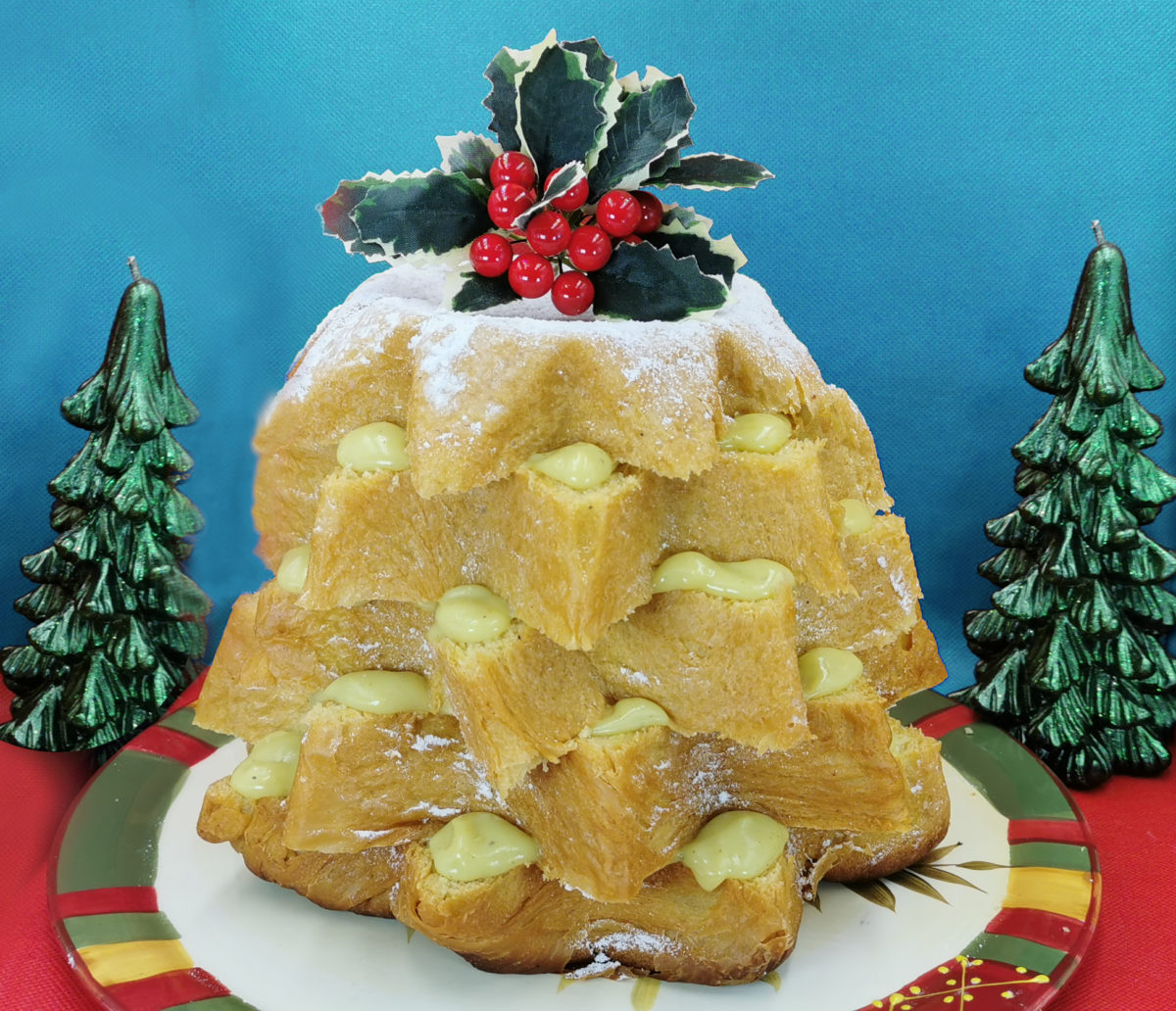
How do you make traditional homemade Pandoro?
Make a pre-ferment and enrich it in stages with flour, sugar, and butter, respecting the rising times. Create the laminated dough by incorporating cold butter through successive folds and cold rests. Place the dough in the mold, let it rise until it reaches the edge, and bake starting at 170°C, then lowering to 160°C until cooked through.
Pandoro is a tall cake originally from Verona. It is served as a dessert during the Christmas holidays, is found in every Italian home, and because of its star shape it is loved by both adults and children. The basic recipe is simple and is served with powdered sugar; to enrich it, it can be served with pastry cream, as in my case. See the vegan pastry cream recipe. It requires a little patience because of the long rising times, but it is not actually difficult: you just need to get a mold and that’s it. If it is impossible to find the mold, you can use a large pudding mold in a star shape. I recommend reading the recipe carefully before starting so you can organize the timing and have all the ingredients nearby.
The screen will not turn off while you cook.
Servings: For one 1 kg Pandoro
Ingredients
- 50 g type 0 Manitoba flour (or strong type 0 flour W350)
- 1 tablespoon cane sugar
- 1 sachet saffron or a pinch of turmeric (for color)
- 7.5 g dry brewer’s yeast
- 60 ml warm water
- 200 g type 0 Manitoba flour or strong type 0 flour W350
- 1.5 g dry brewer’s yeast
- 30 g softened butter
- 25 g cane sugar
- 55 ml warm unsweetened plant milk (soy) or cow’s milk
- 200 g type 0 Manitoba flour or strong type 0 flour W350
- 120 g cane sugar
- 30 g softened butter
- 110 ml warm unsweetened plant milk (soy) or cow’s milk
- 1 teaspoon salt
- 1 vanilla bean or a pinch of extract, or a pinch of vanilla powder
- 140 g room-temperature butter for the dough

Instructions
The first step is to make the pre-ferment. Start by placing the 7.5 g of dry yeast with the 60 ml of warm water, and let it rest for 10 minutes to activate.

This is how it looks once active.
In a large bowl that will gradually hold the following doughs, place the activated yeast, the tablespoon of sugar, the saffron, and the 50 g of flour.
Stir well; you will notice the result is quite liquid. Cover it and let it ferment in the oven with the light on.
After 1 or 2 hours, when you notice that the dough has many little holes or irregularities, the pre-ferment is ready.
In a small bowl, place the 55 ml of warm milk and the remaining 1.5 g of dry yeast, cover, and let activate for 10 minutes.
Once the yeast is activated, pour it over the pre-ferment dough, and also add the 25 g of sugar and the 200 g of flour. Mix the dough well until you have a smooth dough.
Add the 30 g of softened butter.
Knead very well until the dough absorbs all the butter. Shape a ball and place it in a large bowl greased with butter, cover, and place in the oven with the light on until doubled in volume.
After 1 or 2 hours, check that it has doubled in volume.
Remove it and place the dough in a stand mixer for kneading. If you do not have one, knead by hand, but it will require a little more work (about 15 minutes). Gradually pour in the 110 ml of warm milk.
Add the remaining 200 g of flour, 120 g of sugar, the salt, and the vanilla.
Knead until you have an even dough. At this point, add the remaining 30 g of butter; if using a stand mixer, this will be after about 3-5 minutes, or about 15 minutes if kneading by hand.
Place the dough on a floured surface and fold it over itself 3-4 times, until you create a smooth, even ball.
Place it to rest in a bowl previously greased with butter. Cover it and place it in the oven again with the light on.
After about a couple of hours, check that it has doubled in volume.
Remove it and wrap it in plastic wrap. Place it in the refrigerator for about 30 minutes or in the freezer for about 10 minutes, because the dough needs to be very cold.
While the dough is chilling, take out the 140 g of butter; it needs to be at room temperature. Cut it into thin slices so it is easier to place on the rolled-out dough. When the dough is very cold, remove it, place it on a well-floured surface, and roll it out well with a rolling pin, forming a square.
Using a pastry brush or a spoon, spread the 140 g of butter without getting too close to the edges.
Fold the sides, first one and then the other, toward the center, as if wrapping a gift.
Then fold the top side and the bottom side toward the center.
Then fold it in three; that is, one part toward the center and then the other, creating a rectangle.
Gently flatten it with the rolling pin, being careful that the butter does not come out of the dough. Turn the dough.
Wrap it in plastic wrap and place it in the refrigerator for about 20 minutes so the butter chills and firms up a little.
Repeat this process of rolling out, folding in three, and placing in the refrigerator two more times. In other words, it will go into the refrigerator three times in total.
Remove it from the refrigerator and, on the floured surface, make a smooth, even ball by folding the edges toward the center and rolling it on the surface.
Grease the pandoro mold perfectly with butter and place the dough inside, with the smoothest side of the dough (without the folded edges) at the bottom.
Place a piece of plastic wrap over it without pressing it and put it in the turned-off oven to rise until the dough reaches one finger below the edge. This should take about 5-7 hours.
Preheat the oven to 170°C (335°F). Place it on the second oven rack and bake at 170°C (335°F) for 20 minutes, then lower the temperature to 160°C (320°F) for another 35-40 minutes. When you see it is already golden, about halfway through baking, cover it with aluminum foil so it does not burn. Before removing it from the oven, check doneness as you would with any other cake, using a long toothpick or a thin knife.
Once cooked, remove it from the oven and leave it in the mold for about 10 minutes. Then remove it from the mold and place it on a wire rack, covering it with a cotton cloth so it cools completely.

Once cool, sprinkle with a little powdered sugar and enjoy. Or you can cut it into slices and spread a layer of vegan pastry cream between each slice, stacking it like a tower to make it even more indulgent.


Enjoy your meal!
Reviews
There are no reviews yet.
- 50 g type 0 Manitoba flour (or strong type 0 flour W350)
- 1 tablespoon cane sugar
- 1 sachet saffron or a pinch of turmeric (for color)
- 7.5 g dry brewer’s yeast
- 60 ml warm water
- 200 g type 0 Manitoba flour or strong type 0 flour W350
- 1.5 g dry brewer’s yeast
- 30 g softened butter
- 25 g cane sugar
- 55 ml warm unsweetened plant milk (soy) or cow’s milk
- 200 g type 0 Manitoba flour or strong type 0 flour W350
- 120 g cane sugar
- 30 g softened butter
- 110 ml warm unsweetened plant milk (soy) or cow’s milk
- 1 teaspoon salt
- 1 vanilla bean or a pinch of extract, or a pinch of vanilla powder
- 140 g room-temperature butter for the dough